
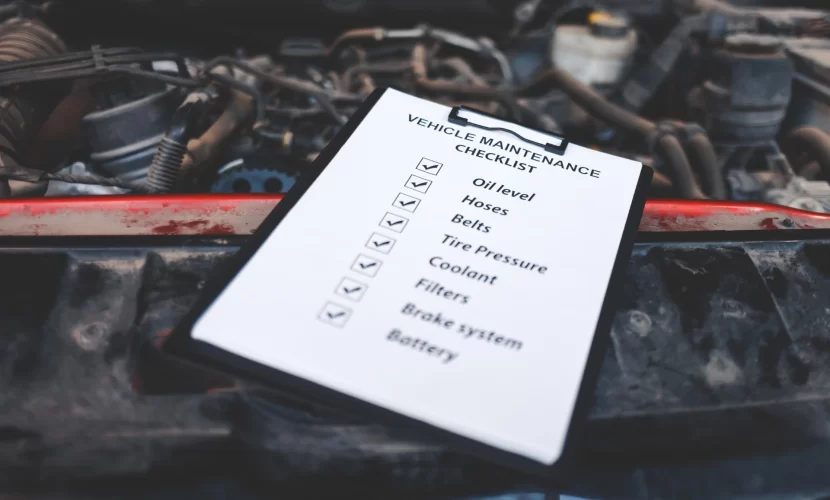
Car Maintenance Schedule: What to Service & When (Complete Checklist)
Not sure what your car needs or when it needs it? This complete car maintenance schedule breaks down every service by kilometre milestone, from routine oil changes to major high-mileage work, so you can stay ahead of costly repairs.
Keeping up with a car maintenance schedule is one of the simplest ways to protect your vehicle, your wallet, and your safety on the road. For over 40 years, Master Mechanic has helped Canadian drivers across Southern Ontario stay ahead of costly repairs.
Whether you drive a brand-new sedan or a well-loved SUV with serious mileage on it, knowing which services fall due and when helps you avoid expensive repairs before they have a chance to develop. This complete checklist walks you through every major service milestone, so you always know what needs attention and when.
Summer driving in Ontario adds its own demands. Heat stresses your cooling system, AC, and tires. Longer road trips put more kilometres on your vehicle in a shorter stretch of time.
That makes summer one of the best moments to check where you stand on this schedule and book anything that’s overdue.
Why a Maintenance Schedule Saves Money and Stress
Most vehicle problems don’t appear overnight. They build quietly over thousands of kilometres, which is why sticking to a regular maintenance schedule is so beneficial. Catching worn brake pads or low brake fluid before they cause a breakdown saves you money, time, and a lot of stress on the road.
The things that seem minor, a slow oil leak, a slightly low tire, a filter that’s never been changed, have a way of compounding into something much costlier. Routine maintenance is how you stay ahead of that curve and keep your vehicle running well for the long haul.
The Complete Car Maintenance Checklist by Mileage
Every vehicle has its own service history, but most cars follow a similar maintenance schedule based on kilometre milestones. The intervals below cover the services your vehicle needs, from routine oil changes to major high-mileage work.
Check your owner’s manual to confirm any intervals specific to your make and model, and use your vehicle identification number (VIN) to account for any services that may already be on record.
Every 8,000 km: The Essentials
These are the services your vehicle needs most frequently. Skipping them is where most mechanical problems start.
1. Oil and filter change
Engine oil breaks down over time and loses its ability to lubricate properly. Most cars running conventional oil need oil changes every 5,000 to 8,000 km. If your vehicle uses synthetic oil, you may stretch that interval a little further, but check your owner’s manual for the exact recommendation.
During the summer, heat accelerates oil degradation, so don’t push past your service interval.
2. Inspect tires and check tire pressure
Inspect tires at each oil change for tread depth, uneven wear, and cracks. Tread depth should be at least 1.6 mm, although most technicians suggest replacing tires well before that limit.
And remember that summer heat can raise tire pressure too much, leading to uneven wear and reduced traction.
Pro Tip: Compare tire pressure to the recommended level found on the sticker inside the driver’s side door.
3. Tire rotation
Rotating your tires every 8,000 km helps even out wear on all four tires, extending their usable life. This service is a quick and low-cost way to help your vehicle track straight and get more use from your tires before replacement.
4. Visual inspection
A quick check of your lights, wiper blades, belts, and fluid levels takes minutes but catches problems early. Ask our technicians to walk you through what they find at every visit.
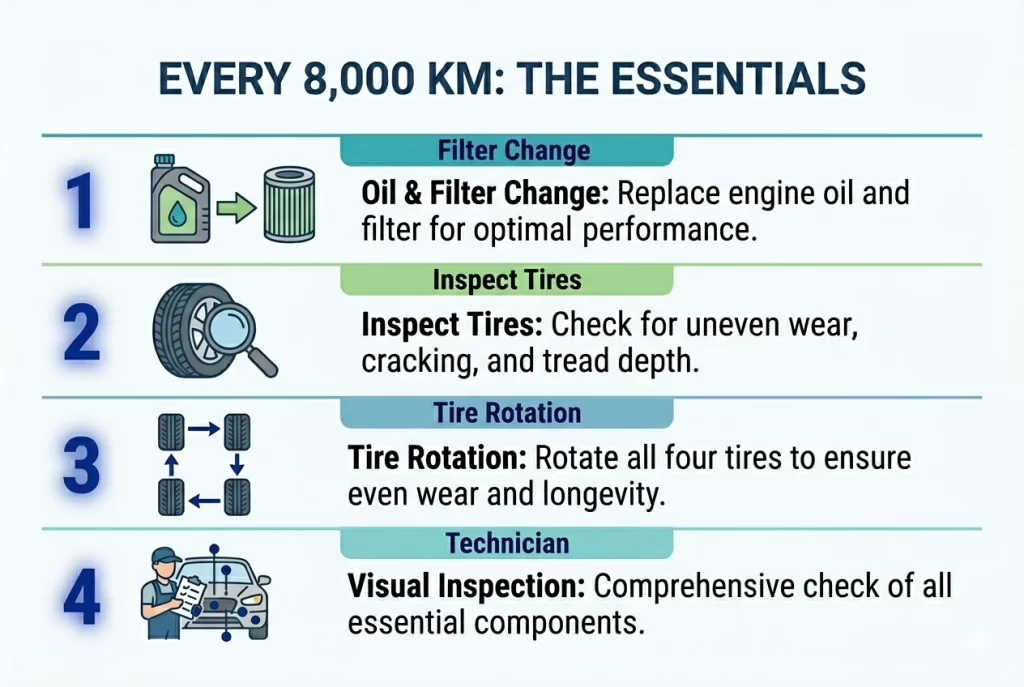
Image Source: Gemini 2026
Every 20,000 km: Fluids and Filters
1. Cabin air filter replacement
Your cabin air filter traps dust, pollen, and road debris before it enters the passenger compartment. In summer, a clogged filter makes your AC work harder and reduces air quality inside the vehicle.
If it’s been over 20,000 km since your last replacement, it’s time to change it.
2. Engine air filter inspection
The engine air filter protects your engine from debris and dirt. A dirty filter reduces fuel efficiency and can cause rough idling. Inspect the engine air filter at 20,000 km and replace it as needed to keep your engine running cleanly.
3. Windshield wiper blade replacement
Summer thunderstorms demand blades that can keep up. Most wiper blades last about 12 months or 20,000 km. If yours are streaking or squeaking across your windshield, swap them before you need them most.
4. Brake inspection
Your brakes deserve attention at every major service interval. Have our technicians check brake pad thickness, inspect rotors for wear, and confirm the brake fluid level is correct.
Most brake pads need replacing somewhere between 40,000 and 80,000 km, but driving habits and road conditions affect that range.
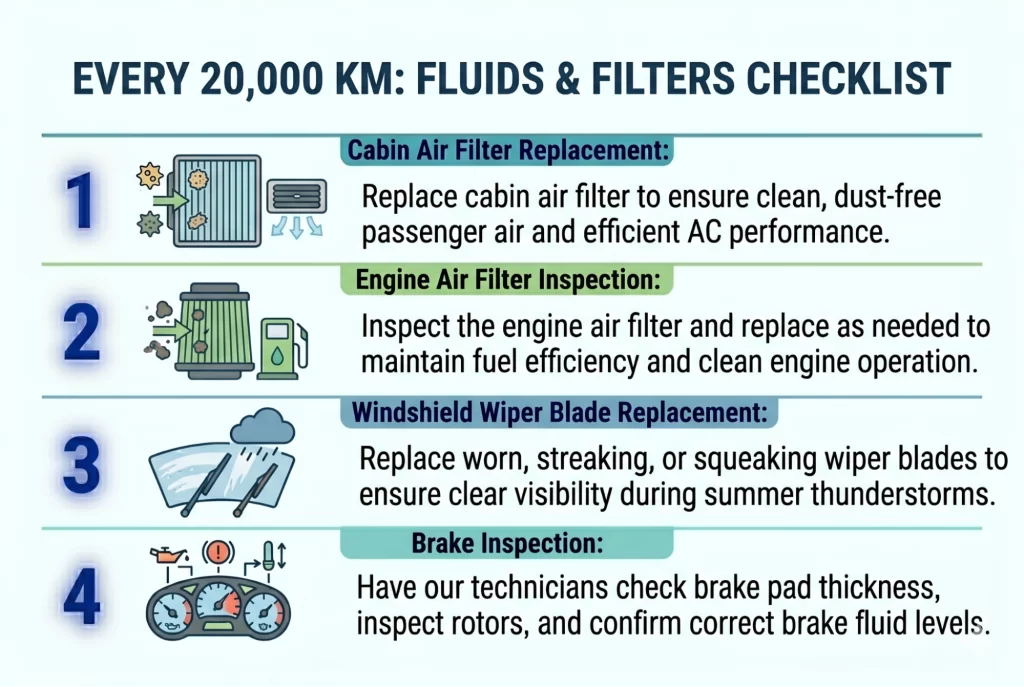
Image Source: Gemini 2026
Every 50,000 km: Systems Check
1. AC inspection and service
Your air conditioning system relies on refrigerant, a compressor, and a series of seals and hoses that degrade over time. A summer AC failure is more than uncomfortable.
At the 50,000 km mark, have your AC system inspected for refrigerant levels, leaks, and overall performance before the heat peaks.
2. Coolant flush
Your cooling system keeps your engine from overheating, and summer is when it works hardest. Over time, coolant becomes acidic and loses its ability to protect engine components. A coolant flush removes old fluid and replaces it with fresh coolant.
This is one of the most overlooked services on any car maintenance schedule, and one of the most important.
3. Fuel filter replacement
Your fuel filter keeps dirt and debris out of your engine by filtering the gas before it reaches the fuel injectors. Most vehicles need a fuel filter replacement around the 50,000 km mark, though your owner’s manual will confirm the right interval for your car.
A clogged fuel filter can cause poor acceleration, rough idling, and long-term engine damage. Preventive maintenance saves you from all these headaches.
4. Transmission fluid check
Transmission fluid lubricates the complex internal components of your transmission. Inspect it around 50,000 km and replace it between 50,000 and 100,000 km, depending on your vehicle mileage and driving habits.
City driving with frequent stop-and-go traffic degrades fluid faster than highway driving. Have your transmission fluid checked to make your car last longer.
5. Spark plugs inspection
Worn spark plugs affect fuel economy, engine power, and cold starts. Most standard spark plugs last about 50,000 km. Have them inspected at this milestone and replaced as needed.
6. Belt and hose inspection
Rubber degrades with heat, age, and kilometres. Summer heat accelerates this process. Have our technicians inspect all belts and hoses for cracking, swelling, or wear. The serpentine belt in particular drives your alternator, power steering pump, and AC compressor.
A belt that snaps on the road means a tow and costly repairs. A belt replaced at the shop means peace of mind.
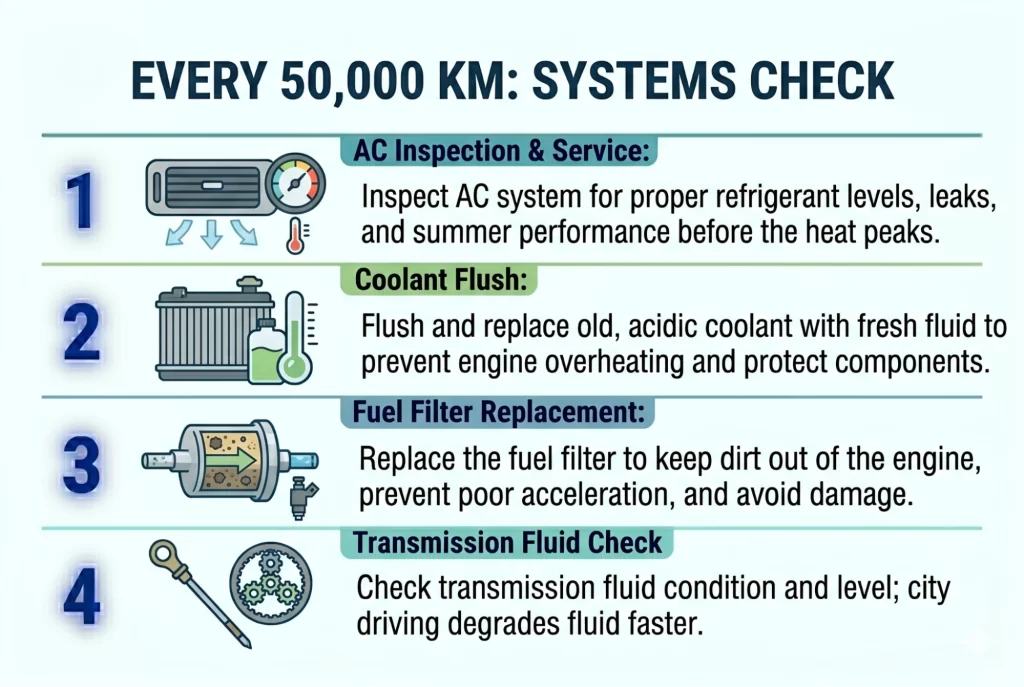
Image Source: Gemini 2026
Every 100,000 km and Beyond: Major Service
1. Battery test
Car batteries typically last three to five years regardless of vehicle mileage. Extreme temperatures, both heat and cold, put stress on your battery, and summer heat in particular accelerates fluid evaporation and corrosion.
At 100,000 km or every three years, have your battery tested to assess its remaining capacity.
2. Brake fluid flush
Brake fluid absorbs moisture from the air over time. As moisture builds up, braking performance can become inconsistent, especially in heat. A brake fluid flush replaces contaminated fluid and restores proper response.
3. Power steering fluid flush
Degraded fluid leads to stiff steering, pump wear, and leaks. If your vehicle has hydraulic power steering, the power steering fluid should be inspected and flushed at high mileage.
4. Timing belt replacement
Not every vehicle has a timing belt, but if yours does, this is a critical service. Most manufacturers recommend replacement between 100,000 and 160,000 km.
A broken timing belt can cause severe engine damage, so follow the manufacturer’s schedule closely.
5. Full suspension inspection
At high mileage, bushings, ball joints, tie rods, and shock absorbers start to wear.
A full suspension inspection tells you what’s still performing and what needs attention before it affects how your car handles on the road.
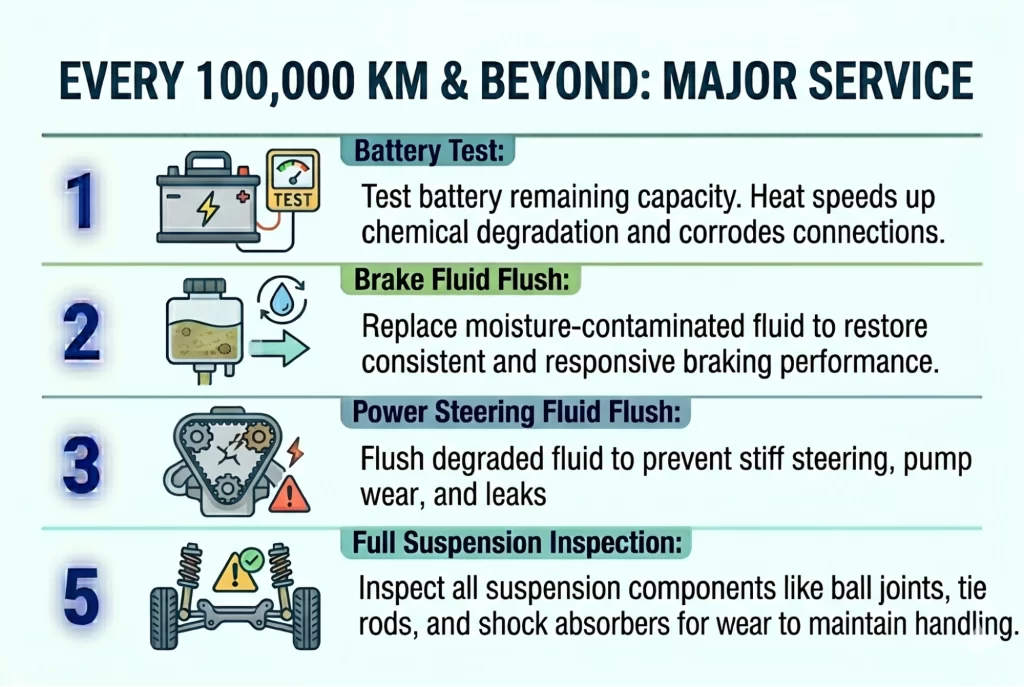
Image Source: Gemini 2026
Your Printable Car Maintenance Checklist
Use this section as a quick-reference guide to track where your vehicle stands:
| Interval | Task | Status |
|---|---|---|
| Every 8,000 km | Oil and filter change | |
| Inspect tires (tread depth, pressure, condition) | ||
| Rotate tires | ||
| Visual inspection (lights, wipers, belts, fluids) | ||
| Every 20,000 km | Cabin air filter replacement | |
| Engine air filter inspection | ||
| Windshield wiper blade replacement | ||
| Brake inspection (pads, rotors, fluid level) | ||
| Every 50,000 km | AC inspection and service | |
| Coolant flush | ||
| Fuel filter replacement | ||
| Transmission fluid check | ||
| Spark plugs inspection | ||
| Belt and hose inspection (inc. serpentine belt) | ||
| Every 100,000 km+ | Battery test | |
| Brake fluid flush | ||
| Power steering fluid flush | ||
| Timing belt replacement (if applicable) | ||
| Full suspension inspection | ||
FAQs About Your Car Maintenance Schedule
Most vehicles need an oil change and tire rotation every 8,000 km. Larger services fall at 20,000, 50,000, and 100,000 km milestones. Check your owner’s manual for intervals specific to your make and model.
Check your owner’s manual or use your vehicle identification number (VIN) to look up your service history. Your technician can also walk you through what’s due at your next appointment.
Small issues compound quickly. A clogged filter, worn brake pads, or degraded coolant can lead to significant engine or brake damage if left unaddressed. Staying on schedule saves you money and keeps your vehicle safe.
Yes. Heat accelerates wear on your battery, coolant, belts, and AC system. If you’re heading into summer with high mileage, it’s a good time to inspect tires, check fluids, and book any overdue services.
Key Takeaways
- A consistent car maintenance schedule helps you avoid expensive repairs and keeps your vehicle running safely for the long haul.
- Oil changes, tire rotations, and inspections should happen every 8,000 km; don’t skip the basics.
- Summer heat accelerates wear on your coolant, AC, belts, hoses, and battery; use the season as a prompt to check your schedule.
- Your owner’s manual and VIN are the most reliable resources for confirming the right service intervals for your specific vehicle.
- All services at Master Mechanic are warranty-approved, and our technicians walk you through exactly what your car needs at every visit.
Key Takeaways
- A consistent car maintenance schedule helps you avoid expensive repairs and keeps your vehicle running safely for the long haul.
- Oil changes, tire rotations, and inspections should happen every 8,000 km; don’t skip the basics.
- Summer heat accelerates wear on your coolant, AC, belts, hoses, and battery; use the season as a prompt to check your schedule.
- Your owner’s manual and VIN are the most reliable resources for confirming the right service intervals for your specific vehicle.
- All services at Master Mechanic are warranty-approved, and our technicians walk you through exactly what your car needs at every visit.
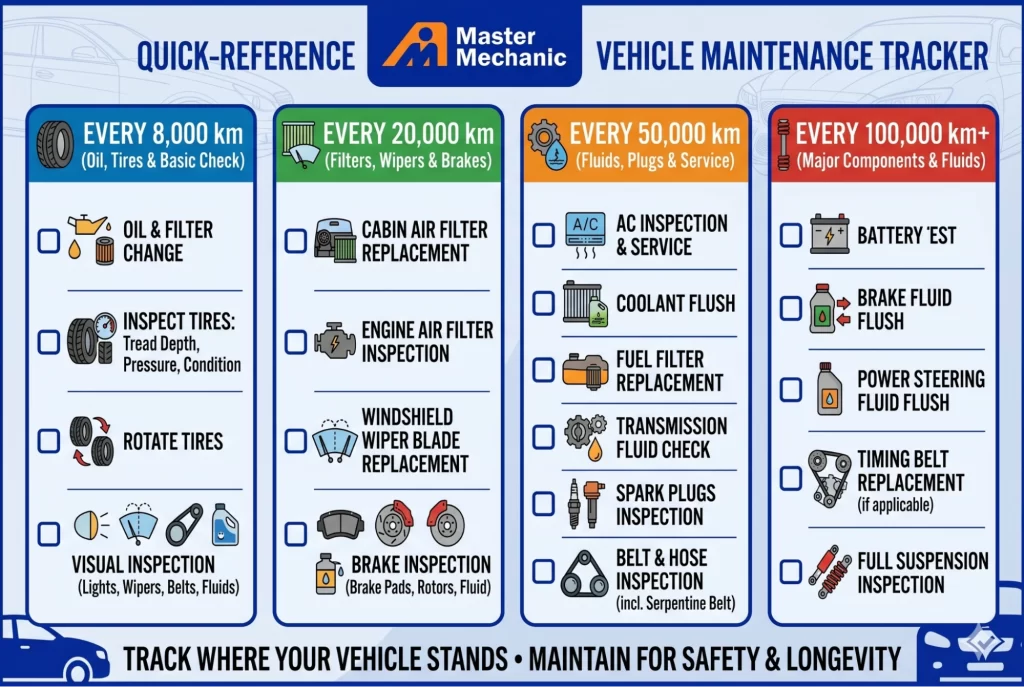
Image Source: Gemini 2026
Keep Your Vehicle on the Road for the Long Haul
A maintenance schedule isn’t complicated, but it does require consistency. The vehicles that last decade after decade aren’t the ones that got lucky; they’re the ones that got looked after.
Our technicians walk you through exactly what your vehicle needs at every visit, what should be done now, and what can safely wait. No pressure, no guesswork, just honest advice from people who genuinely care about keeping you safe on the road. Each Master Mechanic location is locally owned and operated by someone in your community: a neighbour who has a direct stake in the quality of every service they provide.
All services are warranty-approved, so you leave with the work done and the peace of mind to match.
Find a Master Mechanic location near you and book your appointment today. We’re Canadian-owned and work on a locally operated model.